Swindon Railway Station
The Curious Incident of the Dog in the Night-TimeSwindon station is the first major transport threshold on Christopher’s journey to London: a place whose railway connections make escape possible, but whose crowds, noise, and confusing spaces test his ability to keep moving. He reaches it by applying rules to the town around him, then boards a train after coping with the station’s overwhelming interior.
A route made from rules
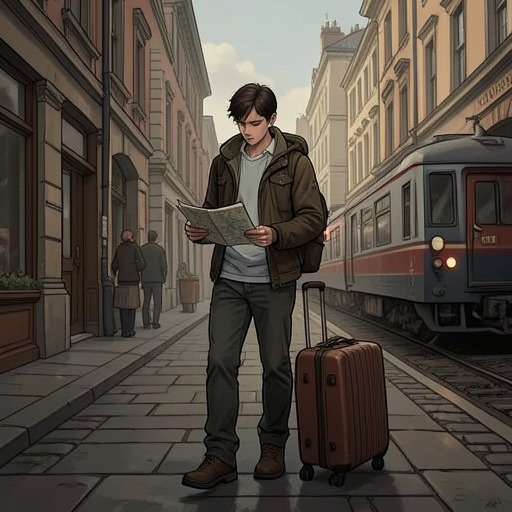
Christopher’s plan to live with his mother depends on taking a train from Swindon station. He draws on what he knows from his train set: check a timetable, go to the station, buy a ticket, read the departure board, and find the right platform. The model gives him a sequence of actions for a journey whose emotional stakes are much harder to manage than its practical instructions.
When he loses sight of a sign and realizes he is lost, Christopher uses a systematic search method to find the station. He walks in a clockwise spiral, taking every right turn until he returns to a road already crossed, then takes the next left and repeats the process. Concentrating on these rules helps him make a mental map of the town centre and disregard some of the people and noise around him.
The station as an obstacle
The actual station does not resemble the simple two-room building on Christopher’s train set, with a ticket office and waiting room joined by a corridor. He remembers Swindon station as a tunnel and stairs, a shop and café, and a waiting room; because fear interferes with his attention, he identifies this picture as an approximation rather than a precise map.
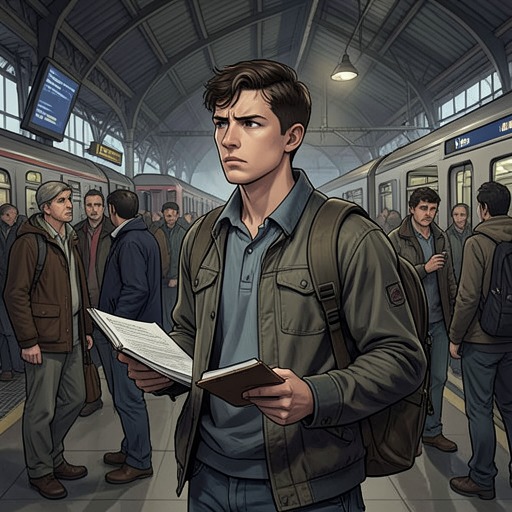
The tunnel makes the station feel perilous. People stream in and out, their movement echoes, and the only way onward is down the passage. The smell of toilets and cigarettes adds to the strain. Christopher holds the edge of a sign warning that customers seeking car-park access should use an assistance phone, trying not to fall or crouch on the ground. He wants to go home, yet is also afraid to return, and cannot settle on a plan amid so many competing sights and sounds.
He covers his ears to think and decides he must stay in the station to catch a train. With no place to sit near the entrance, he walks down the tunnel while concentrating on a sign reading WARNING CCTV in operation. The passage is not merely a link between parts of the building: for Christopher, crossing it requires a deliberate effort to maintain balance and attention.
A pause, then departure
At the top of the stairs, Christopher finds a room with chairs but rejects it because it is too crowded. Instead, he sits at an unoccupied table in a corner, closes his eyes, and keeps Toby in his hand. He gives Toby two pellets of rat food from his bag and grips his Swiss Army knife in the other hand. When the noise threatens to overwhelm his thinking, he groans quietly and works through a maths problem to clear his mind.
The station also supplies the practical cues that make departure possible. Christopher checks his watch: three minutes have passed since he was at the ticket office, so the train will leave in two minutes. He presses the button, the doors slide open, and he steps through onto the train to London. The station’s significance lies in that double function: it intensifies the conditions he fears, but its routes and timetable carry him beyond them and toward his mother.